ArchiMate Model for Shogi Strategies
Introduction
This page explores how enterprise architecture modeling techniques can be applied to shogi strategy. By using ArchiMate, a standardized modeling language typically used for business and IT systems, we can create a structured way to understand, document, and analyze shogi strategies and their interconnections.
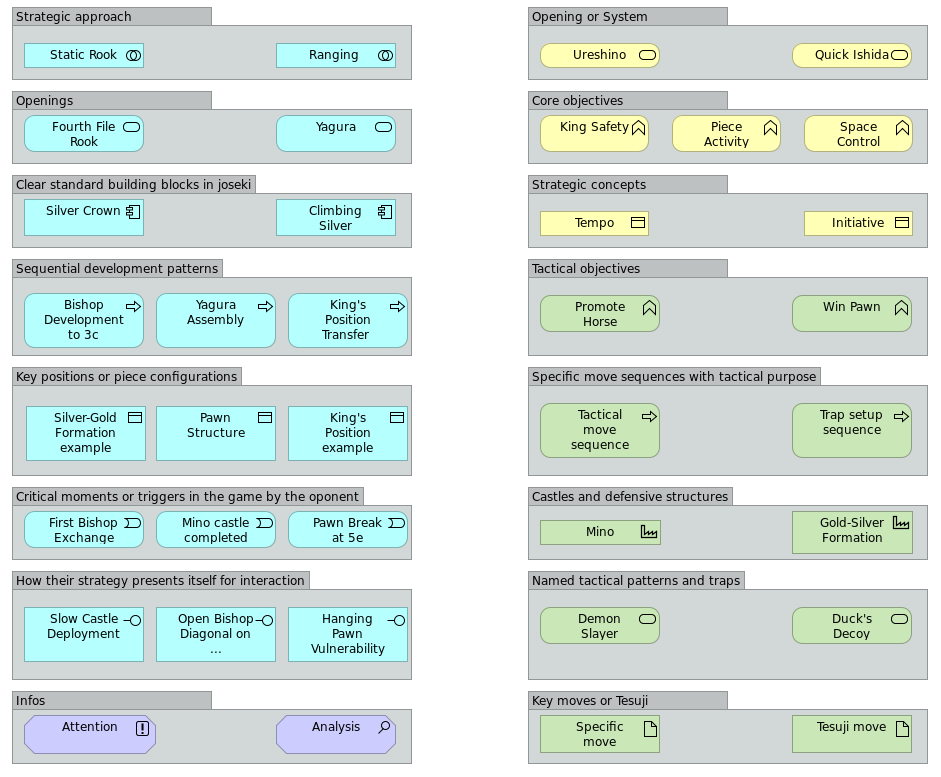
The overview below illustrates the entity types that can be used for modeling shogi concepts across different layers, providing a foundation for a systematic framework to understand strategic elements.
Application Layer (Observable Opponent Strategy)
- Application Collaboration: Strategic approaches (Static Rook, Ranging Rook as Sente/Gote)
- Application Service: Opening systems (Yagura, Fourth File Rook, etc.)
- Application Component: Standard building blocks in joseki (Silver Crown, Climbing Silver, etc.)
- Application Process: Sequential development patterns observed in opponents’ play
- Application Object: Key positions or piece configurations that have strategic or tactical significance
- Application Event: Critical moments or triggers in the opponent’s game
- Application Interface: How their strategy presents itself for interaction (attack vectors, pressure points)
Business Layer (Your Strategy)
- Business Service: Your opening systems and strategic approaches
- Business Function: Strategic objectives (king safety, piece activity, space control)
- Business Object: Strategic concepts (tempo, initiative, compensation)
Technology Layer (Tactical Implementation)
- Technology Facility: Castles and defensive structures (Mino, Gold-Silver formations)
- Technology Function: Tactical objectives (promote horse, win pawn)
- Technology Service: Named tactical patterns and traps (Demon Slayer, Duck’s Decoy)
- Technology Process: Specific move sequences with purpose
- Technology Artifact: Tesuji (key tactical moves)
Motivation Layer (Guidance and Analysis)
- Principle: Key informational guidance (where to focus attention)
- Assessment: Evaluations with links to concrete analysis (Lishogi analysis, variations)
Future Work
This initial overview presents the modeling entities that will be used to build a comprehensive framework for our shogi strategy. In future iterations, these building blocks will be connected to model complete strategic systems and game decisions, creating a knowledge base that goes beyond traditional shogi documentation platforms.